
 Ελληνικά
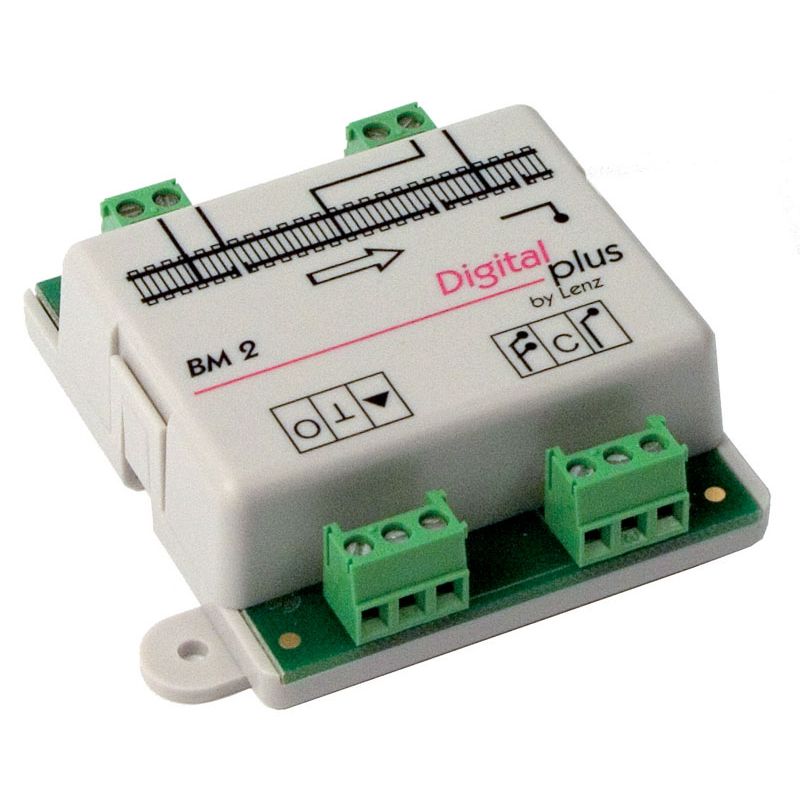
Lenz 22610 – BM2 DCC Brake module, ABC technology
56,00 €
Lenz 22610 – BM2 DCC Brake module, ABC technology
In stock
Description
ABC technology: A Lenz patent that enables the train to slow down in front of a signal and stop with all its functions active. To use the ABC technology, the used locomotive decoder MUST support the protocol and of course, be activated.
Additional advantages of the ABC technology:
All locomotive functions (e.g. front lighting) can still be switched while the locomotive stops in front of the signal.
Programming in operational mode (POM) possible.
The locomotive can reverse away again from the signal!
A locomotive can pass in the opposite direction, even if the signal is at “Stop”.
Shunting is possible, even if the signal is at “Stop”. Simply activate the shunting mode!
No short-circuits when crossing section points between the driving and stopping sections.
BM1: How does the BM1 work?
With little effort, ABC manages to accomplish just what model railway enthusiasts crave: Exact stopping in front of red signals and free passage in the opposite direction. By means of simple modules which supply the braking section in front of a signal, the locomotive decoder receives the signal status nformation: if the signal is “red”, the train will slow down and stop, if the signal is “green”, the train will continue unimpeded.
Technically, this is realised as follows: if the signal is “red”, the BM1 module creates in the braking section an asymmetry in the otherwise symmetrical digital track voltage. This is spotted by
decoders. The result is a gentle braking of the train until it comes to a halt, optionally with the set braking delay or set braking distance.
If the train is not to stop, but to continue unimpeded or to start moving again after the stopping time has elapsed, the BM1 will simply be bridged with a switch.
Compared to the simple BM1, the BM2 module has the following advantages:
In addition to signal stopping, “Slow approach” (HP2) is also possible.
Easy control of the module using light signals and semaphore signals fitted with
switches.
Even rear-powered (pushed) trains (push-pull trains, commuter trains, motor coaches) stop at the right spot.
Depending on the signal setting, you can use the BM2 module to direct locomotives to stop (for
HP0), to pass (for HP1) or to slowly approach (for HP2). Of course, you can set the speed for
the slow approach in the locomotive decoder.
The BM2 has two control inputs. Depending on which one is active, the BM2 sends the information “STOP or “SLOW APPROACH” to the decoder.
Rear-powered trains (pushed) and push-pull (commuter) trains? – no problem!
Divide the section in front of the signal into a driving (A) and a braking section (B).
When the rear-powered (pushed) train in the driving section reaches the braking section, the
BM2 switches the driving and braking sections to asymmetrical digital voltage. As the pushing
locomotive is already located in the driving section at that time, the decoder recognises this
asymmetry and switches to “Stop” or “Slow approach”, depending on the signal setting.
The length of the driving section must be calculated so as to fully accommodate the longest
trains passing this section. The length of the braking section depends on the braking delay
and/or distance set in the locomotive decoder.
Trains passing in the opposite direction do not initiate a braking procedure.
The above procedure requires that the leading coach of the rear-powered (pushed) train
is fitted with a power consumer, e.g. interior lighting.
Using the BM2 at the end of a block section
You can use the BM2 module to complete a block section of BM3 modules. In a typical case,
the entry signal to a station would be at the end of a block section. By setting the entry signal,
you, as the conductor, determine whether an arriving train may or may not enter the station.
The BM2 has a control output designed for this purpose. Connect this output to the BM3 control
input that controls the previous block.
Maximum continuous current-carrying capacity 3.0 A
Voltage at signal input (AC or DC) DC: 11…24 V, AC: 8…24 V
Dimensions 70 x 60 x 20 mm
Related products

Consoles, Accesorry decoders


Consoles, Accesorry decoders

Consoles, Accesorry decoders
Lenz 11100 – LS100 Accessory decoder with feedback capability

Consoles, Accesorry decoders

Consoles, Accesorry decoders

Displays, Storage


Consoles, Accesorry decoders

Consoles, Accesorry decoders