
 Ελληνικά

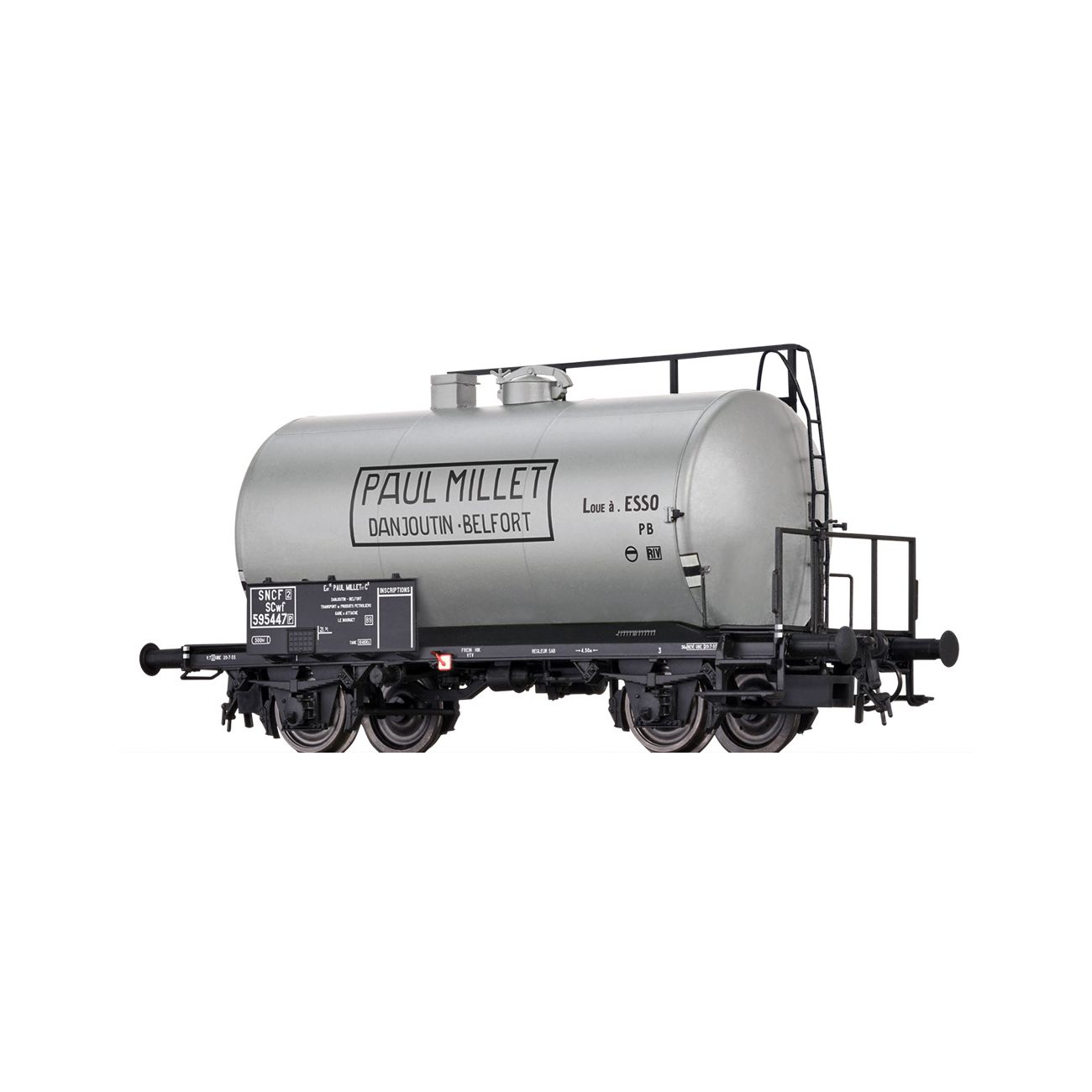
BRAWA 50054 – Uerdingen SCwf tank wagon of the SNCF, Era III
Original price was: 46,90 €.40,00 €Current price is: 40,00 €.
BRAWA 50054 – Uerdingen SCwf tank wagon of the SNCF, Era III
In stock
Description
Lightweight tank wagon Uerdingen SCwf “Paul Millet” of the SNCF
2-axle | Operating No. 595 447 [P]
Highlights:
Extra-attached axle box covers
Extra-attached leaf spring assemblies
Extra-attached brake system
Brake shoes in wheel plane
Extra-attached axle brake linkage
Freestanding grab rails
INFORMATION ABOUT THE PROTOTYPE
30m³ Uerdingen-type tank wagon: General technological advances in lightweight construction and welding technology inspired the Reichsbahn (German State Railway) to dispense with the actual vehicle frame in the design of new tank wagons. Instead, the tensile and impact forces were to be absorbed by the tank as much as possible. The extensive use of welding technology was expected to reduce raw material requirements and manufacturing costs while simultaneously producing more robust vehicles. For this reason, the Uerdingen Wagon Factory received an order in 1938 to develop a lightweight tank wagon with a 30 m³ loading capacity. As early as 1939, the three prototypes were handed over to two private freight wagon leasing companies and the state-owned Economic Research Company (Wifo) for testing. After a small interim series in 1940, series production of the 30 m³ Uerdingen-designed tank wagon began in 1941. The largest customer, with approximately 2,200 units, was the Luftwaffe, followed by Wifo and many smaller companies, resulting in a total of around 3,700 wagons being built. In the post-war period, the Wifo and Luftwaffe wagons were distributed among other wagon operators in both German states. Primarily, larger companies in the mineral oil industry, but also smaller private companies, as well as the DB (German Federal Railway) and DR (German State Railway) themselves, used the wagons in the following decades. A portion of the wagons also remained abroad and were used there by new owners. In 2016, a car could still be found in the internal factory transport system at Haltermann in Hamburg.
Additional information
| Era | |
|---|---|
| Gauge | |
| Railway/Country | |
| Scale |
Related products


Tanks


